








Why Your Sleep Noise Machine Helps at Bedtime but Not Always at 3 A.M.
It’s 3:12 a.m. You fell asleep just fine with a soft wash of sound in the room, and then the night changed: the HVAC clicked on, your partner rolled over and started snoring again, a hallway door slammed, or a siren cut through the window. Now you’re awake, annoyed, and staring at the ceiling wondering whether your sleep noise machine failed you—or whether you’re asking the wrong tool to solve the problem.
Our short answer: yes, a sleep noise machine can absolutely help you stay asleep when the disruption is broad, steady, and part of the room itself. But once the noise is sudden, uneven, close to you, or louder than the sound blanket in the room, bedside masking gets less dependable. That’s usually the point where we’d stop endlessly tweaking the bedroom and start thinking about protecting the sleeper more directly.
When room noise isn’t the whole problem, protect your sleep more directly
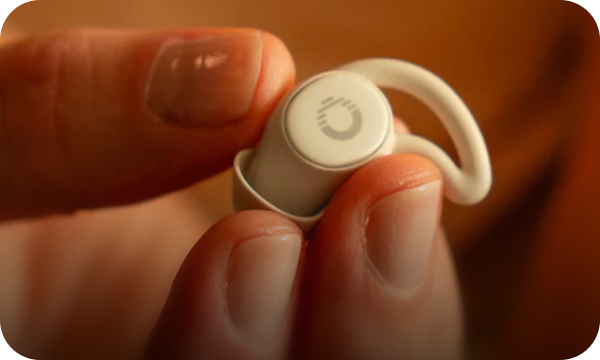
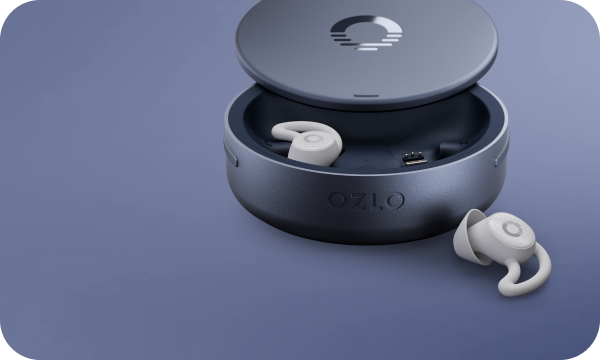
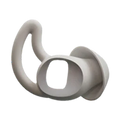
If your wakeups come from snoring, hallway noise, travel, or other unpredictable sounds, bedside masking may not be enough. Ozlo Sleepbuds® are designed to deliver sleep audio comfortably through the night—right where it matters most.
See How Ozlo Sleepbuds® WorkA lot of sleep advice treats noise as a falling-asleep issue. That’s only half the story. Many light sleepers can drift off with white noise, rain sounds, or a fan-like hum in the background. The real frustration shows up later, when a new sound breaks the pattern and pulls the brain’s attention toward it.
That’s why 1–4 a.m. wakeups feel so maddening. A steady sound is often easy for the brain to tune out. A changing sound is not. Snoring that stops and starts, pipes that clank, elevator dings, footsteps in the hall, a dog shaking its collar, a child calling out, garbage pickup at dawn—these aren’t just “noise.” They’re interruptions. Once a sound stands out, the problem is no longer simple relaxation. It becomes a question of whether your setup can keep that interruption from reaching you clearly enough to matter.
We find this framing helps people stop blaming themselves. If you keep waking up, it doesn’t automatically mean you’re “bad at sleeping.” It often means the noise pattern you’re dealing with is no longer a good match for room-level masking alone.
A sleep noise machine works by adding consistent background sound to the room. In the right situation, that’s wonderfully helpful. It can make distant traffic feel less distinct, soften the edges of hallway noise, and reduce the contrast between “quiet room” and “small outside disruption.” In plain English, it gives your bedroom a more stable sound floor.

But it’s still a room-level solution. The sound has to travel through the air, fill the space, and compete with the disruptive sound before that disruption reaches you. If the problem noise is nearby, directional, or sudden, the machine has less margin to work with. A snore six inches away from your ear is not the same problem as soft rain outside the window. Neither is a sharp HVAC click, a hotel door slam, or a neighbor’s bass that pulses unpredictably.
That’s where personal sleep audio changes the equation. Instead of trying to manage the whole room, it delivers sound directly to the sleeper. We think of this as changing the sound path. You’re no longer asking a small device on the nightstand to dominate every corner of a noisy environment. You’re creating a more consistent layer of sound where it matters most: at your ears, all night.
This is the decision many exhausted people are really making, even if they don’t phrase it that way. Not “Does white noise work?” but “Is my noise problem still a room problem, or has it become personal?”
If you want a practical way to judge whether a sleep noise machine is enough, sort your noise into three buckets:
- Usually handled well: steady outdoor traffic, a consistent fan or HVAC hum, light rain, distant neighborhood ambience, and other broad environmental sound that doesn’t change much.
- Sometimes helped, but not reliably: occasional hallway noise, moderate apartment sounds, soft snoring at a distance, periodic building creaks, or hotel noise that comes and goes without getting too sharp or too close.
- Often unreliable for bedside masking alone: partner snoring beside you, sudden door slams, sirens, barking right outside, kids or pets waking unpredictably, loud HVAC cycling, and any close or uneven noise that keeps breaking through.
The pattern matters more than the label. A bedside machine tends to do best when the disruptive sound is steady and farther away. It gets shakier when the sound is intermittent. It struggles most when the sound is close, directional, and unpredictable.
How we’d triage the problem
- Keep the bedside machine if your wakeups come mostly from steady environmental noise and the machine already reduces how noticeable it feels.
- Improve the room setup if the problem is borderline: adjust machine placement, choose a more even sound profile, reduce other room-level leaks, and make sure the volume isn’t too low to be useful or so high that it becomes distracting itself.
- Move to personal overnight audio if the noise is close, sudden, irregular, travel-dependent, or still waking you after repeated room tweaks.
That third step matters. There’s a point where continued fiddling becomes a nightly science experiment with lousy sleep as the cost. If you’re there, a more direct solution isn’t overkill. It’s just the right tool.
How this plays out in real bedrooms and real nights
When the issue is a partner next to you
This is the classic example of proximity beating room masking. A bedside sleep noise machine may help if the snoring is light and occasional, especially if your room already has some ambient sound. But if the snoring is close, rhythmic one minute and explosive the next, many people find themselves trapped in an exhausting loop: raise the machine, still hear the snore, get annoyed, lower it, wake up again.
We’d usually call that a strong case for personal sleep audio. The source is too near and too inconsistent for room sound to cover reliably. Direct-to-ear sleep audio is often the more sensible move because it protects the person trying to sleep without turning the whole bedroom into a louder environment.
When the problem is apartment, city, or hallway noise
This is where a sleep noise machine can still shine—up to a point. If what’s bothering you is broad background city sound, a nearby road, a building hum, or occasional low-level movement in the hall, a bedside machine may be enough. It can smooth the soundscape and make the room feel less acoustically “spiky.”
But if you’re dealing with sudden voices outside your door, elevator dings, doors slamming, sirens, or neighbors who are quiet for an hour and then noisy all at once, reliability drops. Those sharper changes are exactly what wake light sleepers. If your nights depend on what strangers in the hallway decide to do at 2 a.m., personal sleep audio gives you a more controlled experience than a machine on the dresser ever can.
When pets, kids, or HVAC keep changing the night
These are sneaky because they feel domestic and familiar, but familiar noises can still be sleep wreckers. A vent that clicks on and off, a dog pacing and jingling tags, a child calling out, floorboards creaking as someone gets up early—none of these are especially well-behaved from a masking standpoint. They’re uneven. They arrive suddenly. They often happen close enough to stand out.
Sometimes a bedside machine softens the impact enough. Often it doesn’t, especially for light sleepers who are already on edge from repeated wakeups. If your environment can’t stay acoustically stable all night, moving from room sound to personal sleep audio is less about “more tech” and more about finally getting consistency.
When travel is the thing wrecking your sleep
Travel changes the equation fast. Hotels, family guest rooms, shared walls, unfamiliar HVAC systems, elevators, ice machines, street noise, and different mattress layouts all add unpredictability. A bedside machine can help, but it also depends on room setup, outlet location, packing decisions, and whether the room’s noise pattern behaves anything like your bedroom at home.
That’s why travel often reveals the limits of room masking. If your sleep depends on a familiar environment, a portable personal sleep audio solution can be the steadier option because it travels with you and protects your sleep more directly. For readers who are waking in unfamiliar places again and again, this is often the clearest sign that bedside sound alone isn’t enough.
Common mistakes that keep people stuck
The first mistake is assuming louder always means better. It usually doesn’t. If you keep turning the machine up to chase every intrusive sound, you can end up with a room that feels aggressively noisy without actually fixing the breakthrough problem.
The second is treating every sound as equally maskable. A smooth, distant hum is very different from a snort, slam, bark, or click. The machine isn’t broken if it can’t reliably erase the second group; that’s often just the limit of room-level masking.
The third is ignoring proximity. Noise in the room is one thing. Noise beside your pillow is another. When the source is close to your body or inside the bedroom dynamic itself, personal protection usually wins.
And the fourth is overlooking comfort and real-life use. If a solution only works under perfect conditions, it tends not to work for long. The best sleep setup is the one you can actually use comfortably through the night, at home and away.
FAQ
Can a sleep noise machine cover snoring?
Sometimes, but usually only when the snoring is mild, somewhat steady, and not too close. If the snoring is loud, uneven, or right beside you, a bedside machine often won’t be the most reliable option for staying asleep.
Is louder white noise better for middle-of-the-night wakeups?
Not necessarily. More volume can make the room feel fuller, but it can’t guarantee coverage of sharp or nearby sounds. There’s a practical limit where louder room sound adds irritation without solving the breakthrough noise.
Is a bedside machine enough for travel?
It can be, especially if your travel noise is mostly steady and environmental. But if hotels or guest rooms expose you to unpredictable hallway noise, doors, elevators, or unfamiliar sleep setups, personal sleep audio is often more dependable.
Is personal sleep audio only for severe noise problems?
No. We’d think about it any time the wakeups are persistent and the noise is close, irregular, or hard to predict. You don’t need a catastrophic noise environment to benefit from a more direct overnight solution.
The real decision
If your sleep noise machine helps smooth out broad, steady background sound, keep using it. If your nights are being broken by close, sudden, or inconsistent noise—and especially if you’ve already spent too many half-awake hours adjusting the room—there’s a good chance bedside masking has reached its limit. That’s when a personal, all-night sleep audio approach starts making much more sense. For readers who need a drug-free way to stay asleep through real-world noise, Ozlo’s sleep-first approach is built for exactly that threshold: when the room can’t be controlled enough, so the sleeper should be protected directly.
Ready to stop chasing every noise in the room?
For light sleepers dealing with close, sudden, or inconsistent noise, a direct-to-ear solution can be a smarter next step than endlessly adjusting a bedside machine. Explore Ozlo Sleepbuds® for a drug-free way to stay asleep through real-world disruptions.
Shop Ozlo Sleepbuds®

